Author/s:
Nipun Malhotra and Harshita Kumari
Recognition Without Rights: The Haemophilia Case and the Unfinished Promise of the RPwD Act
Recently, the Supreme Court issued a notice to the Central Government on a petition seeking the explicit inclusion of haemophilia—a rare bleeding disorder—under the Rights of Persons with Disabilities Act, 2016 (RPwD Act). The petitioners argued that haemophilia results in serious mobility limitations, continuous medical dependency, and recurrent hospitalisations, affecting everyday functioning. Despite this, individuals with haemophilia reportedly continue to be denied reservation benefits, educational support, and welfare entitlements available to other recognised disabilities. Observing that “the objective of the RPwD Act is inclusion, not exclusion,” the Bench emphasised that the rights of persons with long-term health conditions must be grounded in social justice and equality.
At first glance, this may seem puzzling — haemophilia, thalassaemia, and sickle cell disease are already listed within the 21 specified disabilities in the RPwD Act. The ongoing exclusion therefore raises critical questions: What gaps in implementation persist despite statutory recognition? Why is further inclusion being sought? Addressing these requires a closer examination of the Act’s legislative evolution, its intent, and how it diverges from the earlier Persons with Disabilities Act, 1995.
The Persons with Disabilities Act, 1995 was enacted in response to India signing the “Proclamation on the Full Participation and Equality of People with Disabilities in the Asian and Pacific Region.” It was later replaced by the Rights of Persons with Disabilities Act, 2016, which followed India’s ratification of the United Nations Convention on the Rights of Persons with Disabilities (UNCRPD) in 2007.
The 2016 legislation was transformative in three major ways. First, it shifted from a narrow, medicalised framing of disability to a socio-medical model that recognises how social barriers — not just impairments — restrict participation. Second, it significantly broadened the scope of legal protection by expanding eligibility from 7 disabilities under the 1995 law to a comprehensive set of 21 disabilities. Third, it introduced a rights-based vocabulary consistent with the UNCRPD, replacing welfare-oriented terminology with enforceable guarantees of equality, dignity, and full participation.
To operationalise this broader rights-based vision, the Act now recognises disabilities across a wide functional spectrum — sensory and physical disabilities (blindness, low vision, hearing impairment, locomotor disability, leprosy-cured persons, dwarfism, cerebral palsy, speech and language disability, and acid attack survivors), intellectual and psychosocial disabilities (intellectual disability, mental illness, autism spectrum disorder, and specific learning disabilities), neurological and neuromuscular conditions (muscular dystrophy, chronic neurological conditions, multiple sclerosis, and Parkinson’s disease), as well as blood-related and multiple disabilities (thalassaemia, haemophilia, sickle cell disease, and multiple disabilities including deafblindness). Yet, despite such explicit statutory recognition, persons with rare blood disorders continue to face exclusion from reservation and welfare entitlements — a gap now directly challenged through the haemophilia litigation.
While the Act guarantees a set of rights to all persons with disabilities — including equality and non-discrimination, the right to live in the community, protection from abuse and violence, inclusive education, accessible voting, and access to justice — the real differentiation emerges when it comes to entitlements. These are reserved for persons with benchmark disabilities (40% or more of a specified disability), who are entitled to 5% reservation in higher education, 4% reservation in government employment, and free education between 6 and 18 years of age.
However, the 4% reservation in government jobs applies only to five categories of disabilities:
Blindness and low vision; Deaf and hard of hearing; Locomotor disability, including cerebral palsy, leprosy-cured persons, dwarfism, acid attack victims, and muscular dystrophy; Autism, intellectual disability, specific learning disability, and mental illness; and Multiple disabilities arising from the above categories, including deafblindness.
This narrow reservation design — embedded in the Act and replicated across major recruitment systems such as UPSC means that many individuals with legally recognised disabilities, including those who meet the benchmark threshold, remain excluded from affirmative action pathways.
A closer reading of who qualifies for reservation reveals three structural concerns. First, disabilities that are normatively perceived as “visible” or traditionally understood appear to take precedence, whereas “invisible” yet significantly disabling conditions — such as haemophilia, sickle cell disease, multiple sclerosis, and epilepsy — are omitted. Second, the reservation framework continues to mirror the original seven disability categories from the 1995 Act, undermining the expanded intent of the 2016 law. Third, this creates a structural double whammy: those excluded from reservation are often simultaneously screened out of employment as “medically unfit,” leaving them without either a fair chance in open competition or any affirmative action recourse under the PwBD quota.
What this case surfaces, therefore, is not an isolated omission but a systemic design flaw — one where legal recognition does not automatically translate into enforceable inclusion. The current litigation, while centred on haemophilia, therefore speaks to a much broader structural misalignment within India’s disability rights framework: recognition has expanded, but entitlements have not kept pace. A favourable outcome would not only address the exclusion faced by persons with blood disorders, but could help ensure that all disabilities recognised under the Act are meaningfully included in employment, education, and social protection pathways. In this sense, the case represents a pivotal opportunity to bring the rights-based intent of the RPwD Act into full implementation — ensuring that dignity and equal opportunity are not conditional on the type or visibility of a disability.
Nipun Malhotra is founder, Nipman Foundation and director, The Quantum Hub. Harshita Kumari is analyst, The Quantum Hub.
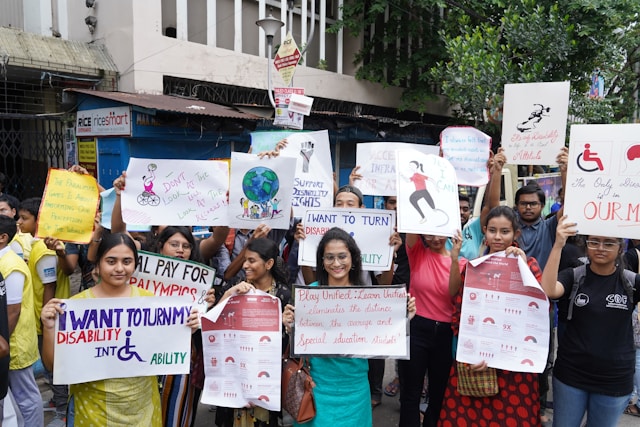
Photo by Dibakar Roy from Unsplash.