Date:
June 2026
Author/s:
The Quantum Hub and National Council of Applied Economic Research
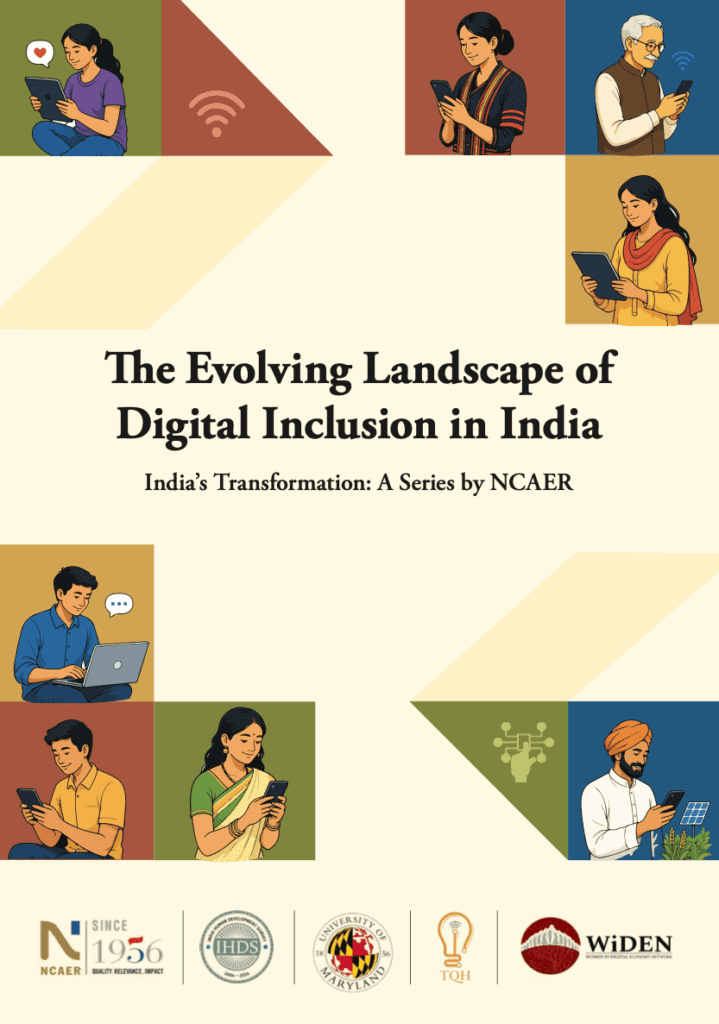
The Evolving Landscape of Digital India
India’s digital transformation over the past decade has been remarkable. Affordable smartphones, low-cost mobile data, and expanding digital infrastructure have brought millions online, making India one of the world’s largest digital societies. Yet beneath this progress lies a more complex reality: access to technology may not always translate into meaningful participation, opportunity, or empowerment.
This report examines the evolving landscape of digital inclusion in India, moving beyond conventional measures of connectivity to understand how individuals and households engage with the digital ecosystem. Drawing on nationally representative data from the India Human Development Survey (IHDS-III), covering more than 47,000 households and 212,000 individuals across the country, the study analyses digital inclusion through multiple dimensions – including device ownership, connectivity, digital use, independence, and outcomes.
Some of the key findings include:
- Mobile access is near-universal, but advanced device ownership is deeply unequal. 95.1% of households own a mobile device, but only 8% own a computer – and the richest quintile is nearly twenty times more likely to own a computer than the poorest.
- India’s internet is mobile-first, and over a quarter of households remain offline. 71.4% of households connect via mobile, while 27.5% have no internet access at all, rising to 52.1% in the poorest quintile.
- The gender divide is the most persistent axis of digital inequality. Among working-age adults, 57.6% of men use the internet compared to just 35.6% of women – and the female-to-male ratio narrows but does not close as economic status rises.
- A hidden divide in digital skills underlies these patterns. 1 in 5 households needs help from outside the household to access digital services, rising to nearly 1 in 3 among households with no education.
- Digital inequality is being inherited across generations. Only 37.8% of children aged 13–16 use the internet, with use rising from 30.2% among children of unschooled mothers to 52.7% among those whose mothers completed higher secondary education.
- The elderly face sharp exclusion. Only 9.4% of individuals aged 60 and above use the internet, raising urgent concerns as welfare delivery moves online.
Building on these findings, the report argues that India’s next digital challenge is not merely expanding connectivity, but ensuring that individuals can use digital technologies effectively, independently, and productively. It highlights the need for policies that strengthen digital literacy, improve access to quality connectivity and advanced devices, support vulnerable populations, and promote meaningful participation in education, employment, finance, public services, and the digital economy.
Ultimately, the report calls for a shift in how digital inclusion is understood and measured. As digital technologies increasingly shape access to opportunities, services, and social participation, success must be evaluated not only by who is connected, but by who can meaningfully participate and benefit.
Citation: Ganguly, D., Agarwal, G., Bharti, A., Vaddadi, H., Chaudhry, S., Choudhuri, P., & Desai, S. (2026). The Evolving Landscape of Digital Inclusion in India. National Council of Applied Economic Research (NCAER) and The Quantum Hub (TQH), Delhi, India.