Date:
Nov 2026
Author/s:
Devika Oberai, Garima Agarwal, Katha Ray, Teesta Shukla, Venika Menon
Research Edited & Directed by:
Mahwash Fatima
One Less Car I Delhi NCR – Rethinking Urban Mobility: Barriers and Opportunities for a Car-Light Future
Delhi has no shortage of transport options, from one of the world’s largest Metro networks and an extensive bus fleet to auto-rickshaws, app-based cabs and bike taxis. Yet, growing private vehicle ownership continues to contribute to congestion, parking pressures and air pollution. While the transition to electric vehicles is an important step towards cleaner mobility, reducing the number of vehicles on the road is equally important. We require a broader rethink of how people travel and how existing transport systems are utilised.
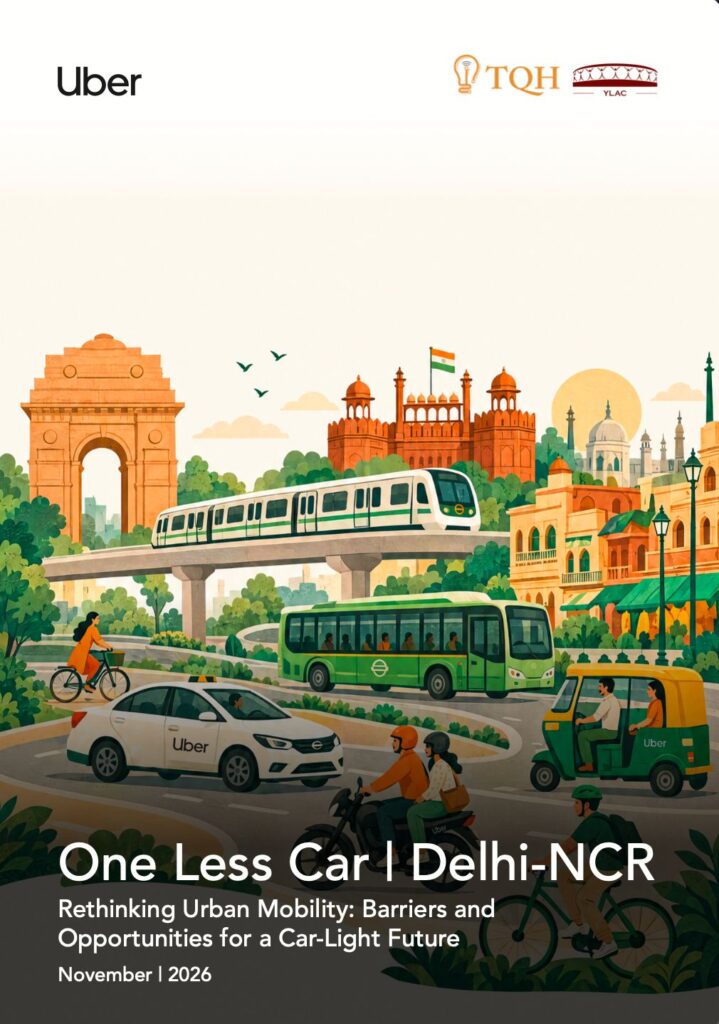
The One Less Car experiment, undertaken by The Quantum Hub (TQH) and Young Leaders for Active Citizenship (YLAC) in partnership with Uber, explored whether people could meet their everyday mobility needs without relying on their personally owned cars or two-wheelers. Conducted across Delhi-NCR in August–September 2026, the experiment followed 34 frequent personal vehicle users over four weeks. Participants set aside their vehicles and relied on alternative modes, supported by a ₹20,000 transport bundle comprising Uber credits and a flexible transport wallet. A mixed-methods approach, combining baseline and endline surveys, daily mobility logs, participant reflections and platform data, captured changes in travel behaviour and perceptions. A follow-up assessment examined whether these changes persisted after the experiment and transport incentives ended.
The findings offer early evidence that car-light lifestyles are possible, but depend on having multiple, well-connected and reliable transport options. Participants used an average of 3 modes per week, up from 1.8 at baseline, reporting greater flexibility, less exposure to traffic and reduced parking hassles. Modelled estimates also indicated an approximately 30% reduction in emissions from participants’ motorised travel. However, gaps in first- and last-mile connectivity, limited bus information, safety concerns, particularly after dark, and ride-hailing service disruptions continued to constrain the experience. Importantly, changes in travel behaviour did not end with the experiment. One week after participants regained access to their personal vehicles and transport incentives ended, 20 of the 34 participants were no longer using their vehicles, while exclusive reliance on personal vehicles had fallen from 12 participants at baseline to just two.
Drawing on these findings, the report outlines five priorities for Delhi: strengthening first- and last-mile connectivity; making journeys easier to plan and pay for; scaling shared mobility and carpooling; improving the safety of public and shared transport; and integrating reduced private vehicle use into the city’s clean-air agenda. The report makes the case for moving beyond vehicle electrification towards a more connected, accessible and efficiently utilised urban mobility system – one that makes better use of the transport options and vehicles Delhi already has.